
Thailand Train Travel Guide: Network, Routes & Booking
Thailand’s passenger railway connects Bangkok with northern cities, the southern mainland and northeastern destinations. Use the network to choose a rail gateway, then check the actual train, departure station and onward transfer for your travel date.
Understand the main rail corridors
- Northern: the route through central Thailand toward Phitsanulok, Lampang, Lamphun and Chiang Mai. Compare daytime and overnight travel.
- Northeastern: routes through Nakhon Ratchasima, with branches toward Nong Khai or Ubon Ratchathani. A journey continuing into Laos needs separate entry and station checks.
- Southern: Hua Hin, Chumphon, Surat Thani and Hat Yai, with branches to destinations including Trang and Padang Besar. Confirm the destination of the selected train.
- Eastern: routes through Chachoengsao toward the Pattaya corridor or eastern inland destinations. Operating patterns and border access require current checks.
- Western branch: the ordinary Thonburi–Kanchanaburi–Nam Tok journey has different station arrangements from many long-distance sleepers.
See the network overview for selected stations. A line on a map does not establish a current through service or an open border.
Choose the correct Bangkok terminal
Many long-distance Northern, Northeastern and Southern trains use Krung Thep Aphiwat Central Terminal. Hua Lamphong and Thonburi remain relevant for other services. Read the complete station name for the selected train rather than treating “Bangkok” as a single boarding point.
MRT Bang Sue serves the Krung Thep Aphiwat terminal area, with walking needed inside the interchange. Arrange a transfer to the station on the ticket. The station guide explains checks for arrival and boarding.
Seat, sleeper and train type are separate choices
A class describes accommodation; a service label such as Express describes a train category. Second class can mean a seat or a sleeper, with different ventilation. A seat remains seated accommodation on an overnight departure.
First-class sleepers commonly have two berths in a compartment; one ticket does not automatically buy exclusive use. Second-class sleepers generally provide individual curtained berths in a shared carriage. Check equipment, access and berth allocation for the actual offer. Use the class comparison before choosing.
Plan destinations beyond the railway
Surat Thani and Chumphon are mainland gateways for Gulf-island journeys. Koh Samui, Koh Phangan and Koh Tao need road and ferry segments; a railway ticket does not automatically include them. Check the pier, pickup point, sailing and missed-connection terms.
Phuket and Krabi need road travel from a suitable rail gateway. Chiang Rai and Pai also require an onward road journey. For international travel, distinguish Vientiane (Khamsavath) from the Laos–China Railway’s Vientiane station, and verify the exact Padang Besar station and border procedures before an onward Malaysian train.
Book a specific journey
Search the exact date and station pair, compare the accommodation, and check the complete price and ticket-delivery conditions. Sales windows depend on the train and journey section; neither a universal 90-day rule nor an agency request guarantees availability.
Enter passenger details as required. If payment is unclear, check the order and contact the seller before buying again. A receipt alone does not establish an issued berth. Verify the travel document, passenger, train, dates and carriage or seat details. See the booking guide.
Prepare for boarding and the journey
Save the complete ticket offline and follow the issuer’s display, print or collection instructions. Carry the required identification. Use current station boards and staff directions instead of old platform photographs.
Check baggage rules and keep exits clear; do not assume rules are waived because other travellers carry large bags. Confirm catering, charging and accessibility where essential. Leave recovery time before separately booked transport. Read the baggage guide and boarding checklist.
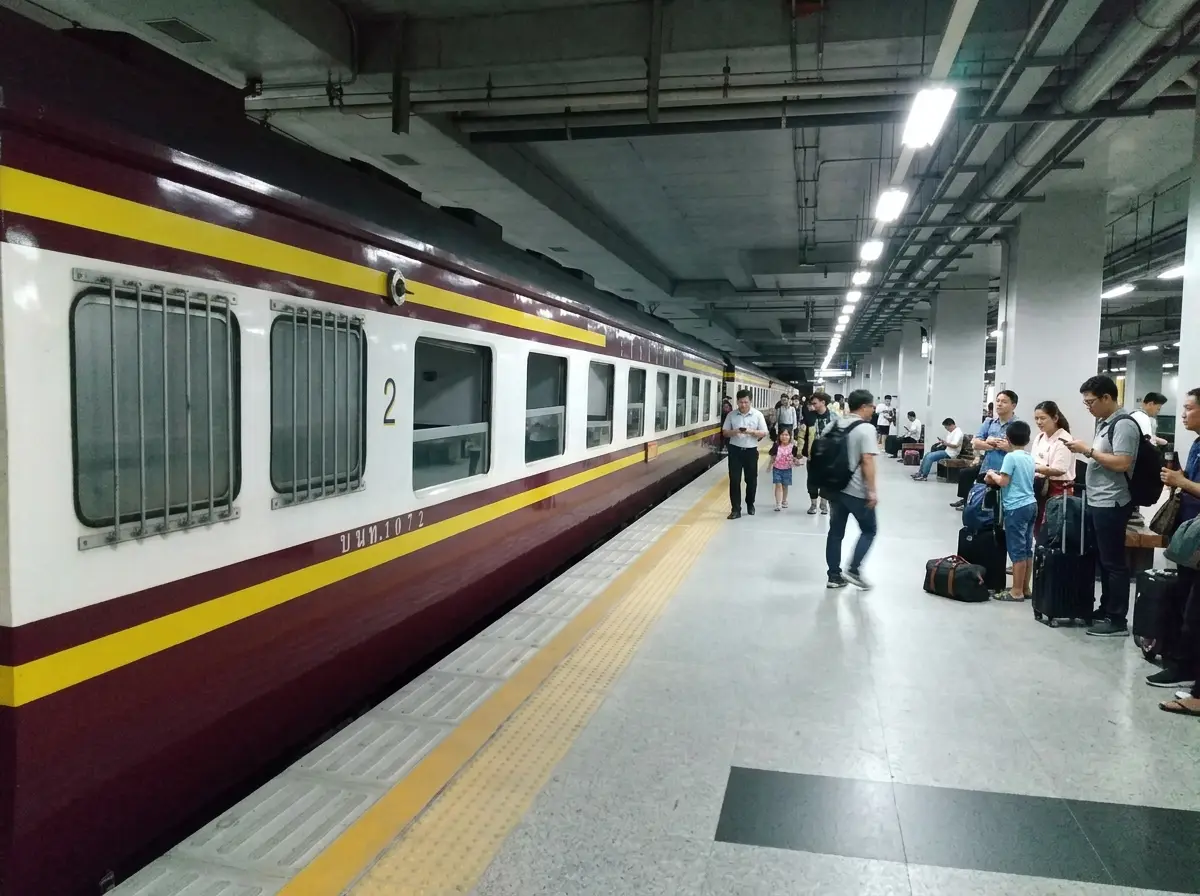
Adapted from: Suikotei · CC BY-SA 4.0 — Illustration adapted from a reference photograph. CC BY-SA 4.0
Current operator information
Use SRT D-Ticket and SRT timetable information for the selected journey. ThailandTrain.org is an independent booking service; it does not sell every SRT service. Compare the total price and the seller’s terms before paying.