
Is a First-Class Sleeper Worth It in Thailand?
A first-class sleeper can be worth the extra cost when you want a closed compartment, but buying one berth does not automatically give you the whole room. Compare the actual products for the same train and date. There is no universal price difference, and a lower second-class berth can be a practical alternative.
Choose around your travel needs
| Your situation | What to compare | Before paying |
|---|---|---|
| Travelling alone and wanting exclusive space | An explicitly offered sole-use compartment versus one berth | Whether another passenger can occupy the other berth and the full sole-use price |
| Two people travelling together | Two first-class berths in the same compartment versus two second-class berths | That the actual assignments are together; two tickets alone do not prove this |
| Keeping the total budget lower | The available upper and lower second-class berths | The complete fare and seller fees, rather than a headline starting price |
| Difficulty climbing | An available lower berth and the carriage layout | Access and any assistance needed; upgrading the class does not itself resolve mobility needs |
| Sensitivity to noise or temperature | The assigned carriage, enclosure and available controls | A door is not a soundproofing guarantee, and temperature controls vary |
What the upgrade changes
First-class sleepers normally have two berths in a compartment with a door. Second-class sleepers usually have curtained berths in a shared carriage. This makes the enclosure the useful starting point for comparison. A first-class label does not promise a hotel-sized room, an ensuite bathroom, a fixed storage capacity or every facility shown in a photograph.
Lower berths are generally easier to access; upper berths require climbing. Layout, washbasins, showers, toilets and power outlets depend on the vehicle. Confirm important facilities for the service offered. Use the first-class versus second-class guide for the wider comparison and the seat versus sleeper guide if you have not decided whether to book a bed.
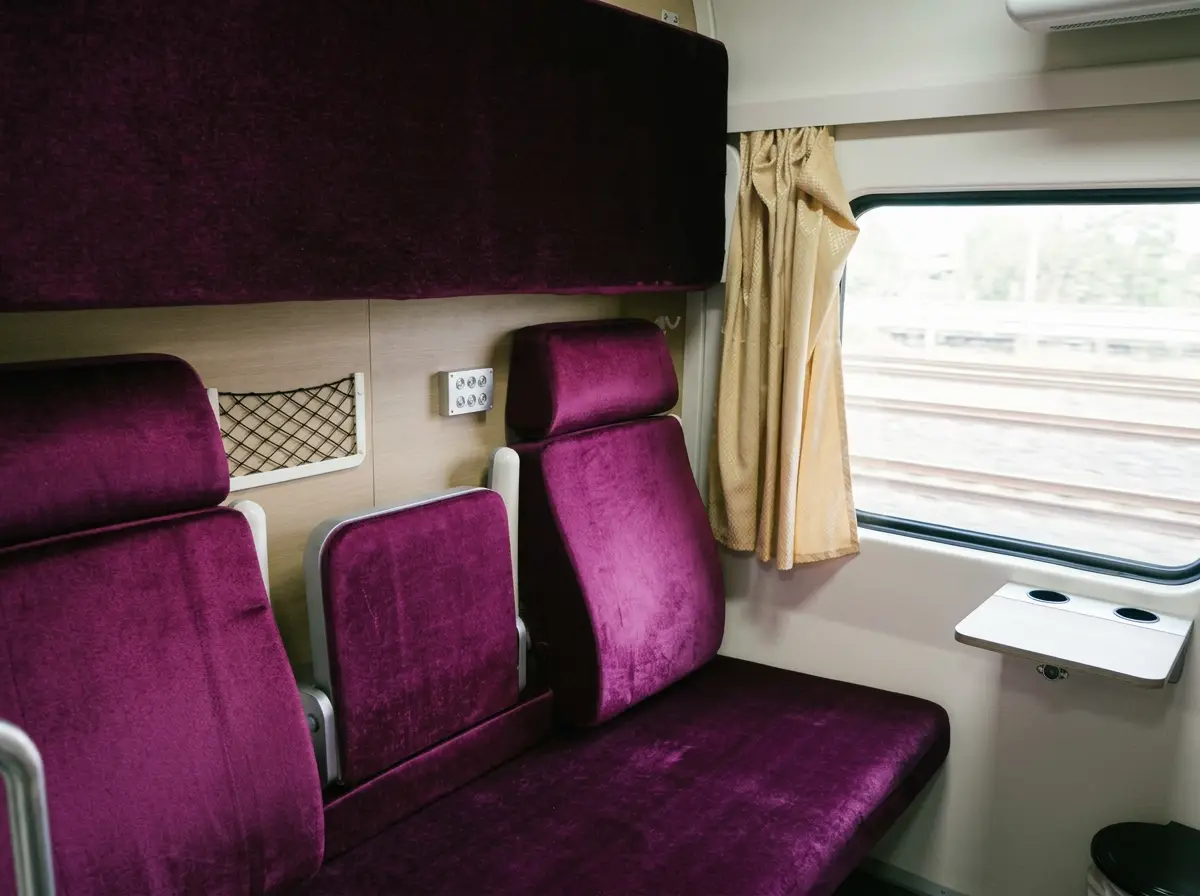
Reference photo: MNXANL · CC BY-SA 4.0 · adapted
Compare the full cost of the arrangement you want
Check the same date, train, route section and berth position. For a couple, compare the total for both people. For a solo traveller seeking exclusive occupancy, compare the explicitly quoted sole-use arrangement, not the price of one berth. Do not assume that buying both berths, a supplement or a discount is offered through every channel.
Old examples in baht or dollars are not current quotes. Include disclosed booking or payment fees and read change and cancellation conditions. ThailandTrain.org is an independent booking service; compare the offer with SRT D-Ticket using equivalent accommodation.
Availability and confirmation
Not every train offers first class, and accommodation can sell out. The Thai government's advance-booking information describes sales up to 180 days for eligible journeys. The exact window depends on the train and section; do not apply a universal 90-day or 180-day rule.
A booking request, payment receipt or berth preference is not proof of a particular assignment. Check the issued ticket, compartment and berth numbers, and follow its delivery and boarding instructions. Read the ticket guide before departure.
Keep the rest of the trip separate
Choosing first class does not guarantee an on-time arrival or an onward ferry connection. For Chiang Mai, compare the current sleeper options. For the islands via Surat Thani, verify each road and ferry segment using the Surat Thani connection guide. Bring a light layer, water and suitable snacks; catering varies.
Search your travel date, then decide whether the actual compartment arrangement and total price justify the upgrade for you.